
[ad_1]
SUVA, Fiji — When four Chinese detectives breezed into police headquarters here in the middle of 2017, it quickly became apparent they weren’t in Fiji’s capital merely to help with an inquiry. Instead, the officers planned to carry out the investigation — into Chinese nationals suspected of running internet scams from the South Pacific island — pretty much as if they were back in China.
“Everything was done by them,” said a former Fijian police officer who was in the Suva headquarters at the time, speaking on the condition of anonymity because he was not authorized to comment publicly. “Fiji police was only there to assist in the arrest, nothing else. All the statements, recordings and the uplifting of all exhibits was done by the Chinese.”
The case was a harbinger of China’s ambitions in the wider Pacific as well as its willingness to conduct investigations and project its police powers overseas, sometimes with little regard for local authorities. But the case also became a catalyst for Fiji to stand up to Beijing and assert its sovereignty.
China’s Global Leap
At every point of the compass, China is quietly laying the foundations of its new international order.
Weeks after the initial four landed in Fiji, scores more Chinese police officers arrived on the island, and 77 suspects, many of them young women, were marched in handcuffs and hoods across the tarmac at a local airport before being flown to China. None was given an extradition hearing. There was no proper documentation, no Interpol involvement, the former Fijian officer said.
“They just came in and did what they wanted,” added another, more senior former officer.
China’s domineering role in the investigation, followed by arrests that human rights activists and Fijian opposition leaders likened to a mass kidnapping, was the culmination of Beijing’s most extensive security partnership in the Pacific, one based on a secretive memorandum of understanding on police cooperation between Beijing and the government of then-Prime Minister Frank Bainimarama.
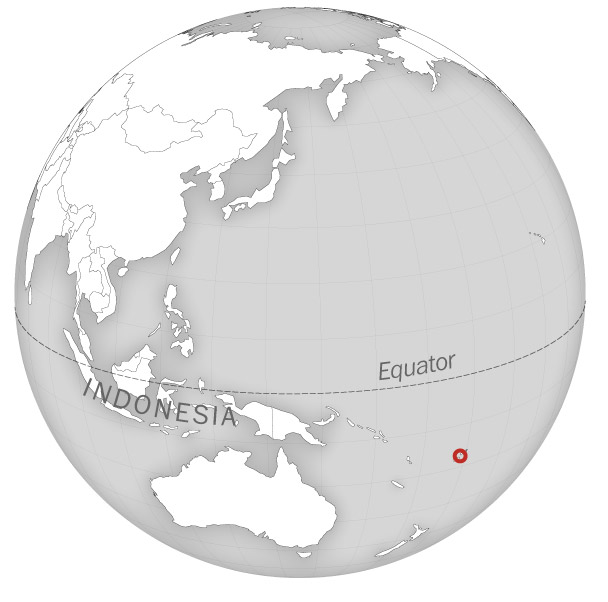
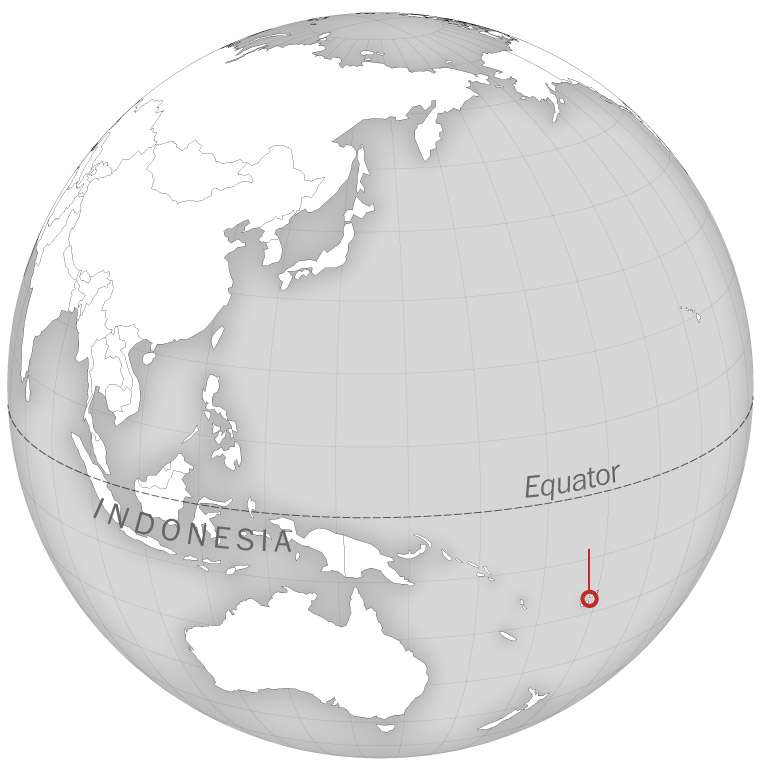
Globe locating Fiji in the Pacific Ocean
It was also a moment that began to sour some Fijians on the growing activities of Chinese officials in Fiji, an example of how Beijing can overreach as it attempts to build its global influence.
“We didn’t even know there was an agreement,” Aman Ravindra-Singh, a lawyer who was one of the few public figures in Fiji to speak out against the arrests at the time, said of the memorandum. “The next thing we knew, there were knocks on people’s doors in [the city of] Nadi and there were Chinese people in full uniform arresting people. It was unheard of. It’s almost like we were invaded.”
The police cooperation between China and Fiji that began in 2011 with the six-page MOU would continue for more than a decade. More than 100 Fijian police officers would train or study in cities across China. Almost two dozen Chinese officers would make the opposite journey, embedding in the Fijian police force for months at a time.
The police agreement provided a blueprint for China to grow its security presence 5,600 miles away in Fiji — from the soft power of people-to-people exchanges to the hard power of arrests, extrajudicial deportations and the transfer of high-tech equipment such as closed-circuit cameras, surveillance gear and drones.
The MOU would also serve as a template for other Chinese efforts in the Pacific. Beijing last year tried — but failed — to forge a sweeping security pact with 10 Pacific island nations.
It has had more success in the Solomon Islands, where China has ramped up police assistance recently, despite objections from Australia and New Zealand. Last year, a security agreement between Beijing and the Solomon Islands inflamed fears that China wants to establish a military base in the strategically important archipelago and, more broadly, become the overarching political power in the region.
At the same time, China has been stepping up its security presence in other countries, including establishing unofficial police stations across North America and Europe to keep tabs on Chinese nationals.
But its actions have been particularly noticeable in this part of the world.
“China is seeking to create an alternative security network across the Pacific,” said Anna Powles, a Pacific expert at New Zealand’s Massey University, noting that in a part of the world where few countries have militaries, the police are a key avenue of influence. “In that respect, the early MOU signed with Fiji in 2011 laid the groundwork.”


China’s push into the region — it is interested in these tiny, underdeveloped Pacific countries not only for their votes at the United Nations but also for their large territorial waters — appears to have taken the United States by surprise, leading to a sudden spurt of engagement by Washington.
The United States and its close ally Australia are boosting aid and diplomacy — as well as promoting their own security agreements — in the Pacific.
President Biden, who hosted Pacific island leaders at the White House last year, abruptly canceled what would have been a historic trip to the region in May to deal with debt ceiling talks, but has scheduled a second summit in Washington this fall.
The moment may be opportune as some Pacific islanders question the nature of their relations with Beijing.
The police agreement in Fiji, in particular, had coincided with increasingly harsh rule by the Bainimarama government.
In December elections, however, Bainimarama lost the prime minister’s office to Sitiveni Rabuka, a longtime rival who ran a campaign critical of China. And in January, in one of his first acts, Rabuka announced he intended to terminate the police agreement with Beijing.
In an interview here, Rabuka said he made the decision because he feared that the MOU risked “treading on people’s personal rights.” He also suggested that his predecessor’s close ties to China had undermined Fijian sovereignty and increased corruption.
“We were so weak, we wanted to befriend them so badly,” he said, “that we turned a blind eye to a lot of the bad things going on.”

Exchanges and abuses

When Fisi Nasario was offered the chance to study in China, the Fijian police officer felt he couldn’t refuse. Nasario normally couldn’t afford to do a master’s degree in Fiji, let alone abroad. But Beijing was offering to pay for his travel, tuition and expenses for two years. He would return home to a promotion and a raise. It was all the result of the policing agreement with China.
Fiji was an international outcast when it inked the MOU in April 2011. The United States, Australia and New Zealand had imposed sanctions after Bainimarama staged an armed takeover five years earlier.
Isolated by traditional allies, Bainimarama turned to a country that didn’t care about his coup: China. (Rabuka also seized power in a coup in 1987, for which he later apologized.)
Today Suva bears the hallmarks of Beijing’s influence. Bainimarama’s “Look North” policy brought in almost $300 million in Chinese aid between 2011 and 2018, though much of it was concessional loans that saddled the island nation with debt. By the time China’s top leader, Xi Jinping, visited Suva in 2014, Fiji was fully aboard what Xi called “China’s express train of development.”
China built a hulking embassy and a Confucius Institute at the university to teach Chinese language and culture. It renovated Suva’s civic center and constructed what was supposed to be a state-of-the-art hospital. On a single day in 2018, Beijing unveiled not one but two major bridges in the capital.


But the memorandum made few headlines in 2011 when it was penned by China’s powerful Ministry of Public Security and Fiji’s Ministry of Defense, National Security and Immigration. Only a preliminary, Chinese-language version appears to have been posted online.
A final, English-language copy obtained by The Washington Post, however, shows that the agreement was more detailed than many of China’s other MOUs with developing countries, most of them in Africa.
Chinese and Fijian officials agreed to cooperate in seven areas including the “arrest of fugitives and recovery of illicit money and goods” and the “prevention of and crackdown on” economic crimes, cybercrimes, terrorism and human trafficking. The two nations also agreed to exchange intelligence, visits, training and equipment. The MOU even lists hotline phone and fax numbers in both countries.
[Click here to read the full memorandum of understanding between China and Fiji]
By 2013, pairs of Chinese officers had begun to embed in the Fijian police force for three to six months at a time, and Fijian officers like Nasario were traveling in the opposite direction.
In August 2017, just as Chinese police were scooping up the 77 suspects in Fiji, Nasario found himself in China, studying alongside officers from across the Pacific and Southeast Asia at Yunnan Police College. There, they learned some basic Chinese and attended lectures on narcotics, forensics and interrogation techniques.
The experience appeared designed not only to educate but also to impress. The international students toured modern Chinese police command centers and marveled at the force’s high-tech drones. They visited tourist destinations like the Great Wall near Beijing and Shanghai Disneyland.
“It was not the China I had in mind before I left,” Nasario, now the Fiji force’s director of police prosecutions, told The Post.
For almost a decade, dozens of Fijian officers would head to China to train or study each year. The exchanges would stop only during the coronavirus pandemic, when China closed its borders. Even then, Beijing sent a special police liaison officer to Suva to continue the collaboration.
“It was the most established police-to-police relationship that China had in the Pacific,” said Peter Connolly, a former Australian army officer who has conducted extensive research on Chinese interests in the region.
“There was a level of exchange and relationship not replicated anywhere else,” he said, adding, however, that the relationship soon could be surpassed by Beijing’s growing security sway in the Solomon Islands.

The arrangement provided public relations boosts for both countries. Fijian officials — many of whom had trained in Australia or New Zealand — now praised Chinese policing as second to none.
For Fiji, the photo ops in China helped distract from human rights abuses at home.
“Under the Bainimarama government, we saw a dramatic increase in arbitrary arrests, torture cases and abuse of process,” said Kate Schuetze, Pacific researcher at Amnesty International.
The issues worsened with the appointment of a former Fiji military commander, Sitiveni Qiliho, as police commissioner in 2015, as the line between police and military became increasingly blurred, she added. It’s unclear whether Chinese training contributed, but it didn’t help, human rights activists said.
Still, Schuetze was shocked in 2017 when photos emerged of the 77 Chinese suspects being loaded onto a plane.
Ravindra-Singh, the lawyer, who fled Fiji last year after he was sentenced to 10 months in prison for criticizing Bainimarama and other officials on Facebook, said it was unclear what happened to those arrested or if they had done anything wrong.
Fiji police denied that the MOU led to any abuses, or that there was anything improper about the 2017 mass arrests. The Chinese Embassy in Suva similarly defended the relationship as “professional, open and transparent.”
It declined to provide information on those arrested, including the charges and outcomes. Instead, it said the 2017 operation was a “good example” of international police cooperation and “in full accordance with relevant domestic and international laws.”
‘Who else are they surveilling?’

China provided Fiji with several million dollars’ worth of equipment during the lifetime of the MOU, including police cars and motorcycles, uniforms and marching band instruments.
When, in 2014, Bainimarama prepared to hold an election he hoped would legitimize his rule, China provided Fijian police with “surveillance and anti-riot equipment” that the Chinese Embassy later said had a “great impact on the success of the election.” Bainimarama won in a landslide.
The technology wowed Nasario, a self-described “island boy.” When he visited a police command center in Kunming, Chinese officers typed a bus’s information into a computer and pulled up live closed-circuit footage from inside, he recalled. Chinese police showed him how they had solved a theft using high-resolution footage from inside a nightclub. And he was blown away by the advanced drones some Chinese police cadets were learning to pilot.
“You see drones everywhere and you think, ‘I wish Fiji could have this,’” he recalled.
He would soon get his wish.
By 2021, two years after Nasario returned home, the Chinese technology on offer had increased in sophistication. That year, China provided Fiji with $700,000 in equipment, including surveillance drones, closed-circuit cameras, and servers enabling police to monitor the footage, according to local news stories and government news releases.
Nasario said Fijian police now use drones to identify illegal marijuana farms in remote areas.
Blake Johnson, an analyst at the Australian Strategic Policy Institute, said the Fiji-China MOU had started small but grown over time into something serious enough to trouble Australian officials.
“Pretty much from the start, Fiji was interested in not just getting vehicles, which is very common in the Pacific, but also communications, surveillance equipment, anti-riot equipment, and that kept evolving,” he said.
The drones and closed-circuit equipment were particularly concerning, he said, “because of how China uses that technology against its own population, raising questions about whether they are encouraging other countries to do the same.”


Inia Seruiratu, who was Fiji’s minister for defense, national security and policing from 2018 to 2022 and is now the opposition leader, denied that Chinese equipment had been used to spy on Fijians.
“Surveillance? They were providing us with musical instruments,” he scoffed, calling suggestions otherwise a “conspiracy theory.”
The specter of Chinese surveillance resurfaced last year when Beijing pushed a sweeping pact with 10 Pacific island nations that would have given China influence over policing, customs, cybersecurity, communications, deep-sea mining and more.
“It was what I would describe as a grand strategic proposal, seeking to integrate political, economic and security initiatives across a key group of Pacific islands,” said Connolly, the Australian analyst.
But the pact fell apart after David Panuelo, then the president of the Federated States of Micronesia, penned a letter to fellow Pacific leaders warning that the agreement was a “smokescreen” for China taking “control.”
“When you go into an agreement like that, you basically give up your sovereignty,” he told The Post in February, a month before losing reelection.
Panuelo later said he’d been followed around Suva by two men from the Chinese Embassy during a summit last year.
Rabuka said that showed he’d been right to stop the police agreement.
“Who else are they surveilling?” asked Pio Tikoduadua, Fiji’s home affairs minister, who oversees the nation’s police and army. “When I meet the Chinese ambassador, I’m going to tell him, ‘Are you looking at me, too?’”
‘China has overplayed its hand’

Rabuka’s Jan. 26 announcement scrapping the MOU came as a surprise, even to U.S. officials who welcomed it as a sign of a pro-American inclination. The new prime minister had hinted at the move on the campaign trail but few expected him to act after only a month in office.
For China, the decision was a humiliating setback — one Beijing is trying to reverse. It has publicly warned it might slash aid to Fiji in response, after privately urging the prime minister not to rip up the policing agreement.
But it comes amid a broader shift, in Fiji and beyond.
“There is a sense in which China has overplayed its hand over the last 12 months,” said James Batley, who served as Australia’s top diplomat in Fiji and the Solomon Islands. “What we are seeing now are various indicators of pushback.”
For Rabuka, canning the MOU was partly aimed at tapping into growing discontent about Beijing’s actions in the South Pacific nation, experts said — not just in policing, but in development, too.
While some Beijing-backed construction projects are popular, others have begun to fall apart or were never completed. Accusations of kickbacks and cut corners abound.
The skeleton of the WG Friendship Plaza looms high above Suva. The Chinese skyscraper was supposed to be the tallest building in the South Pacific. Instead, it remains unfinished after questions about construction standards, the death of a worker and a legal dispute.
Twenty miles away, a medical center Beijing spent $6 million to build in 2014 is already in disrepair.
“Every day I come to work, I pray to God that I don’t lose anyone because of all these issues,” said Doreen Mani, acting senior divisional medical officer at Navua Hospital, where the water and electricity often fail and staff members sometimes have to squeeze two bodies into a single morgue refrigerator. “This hospital is a ticking time bomb.”
The Chinese company that built the hospital recently finished two police stations in Fiji.


Last year, Fiji signed on to the Indo-Pacific Economic Framework for Prosperity, Washington’s answer to Beijing’s Belt and Road Initiative. Yet, the island nation is still reliant on Chinese development assistance, and the decision to scrap the police agreement has put that at risk.
Rabuka has appeared to walk back his decision at times, saying the MOU is merely on ice as his government reviews it. He told The Post that if the review finds that policing has suffered, he could even sign a new agreement with China.
But Rabuka and Tikoduadua, the home affairs minister, said they preferred to work with the United States, Australia and New Zealand.
Australia has been shoring up its own security ties to Pacific island nations in recent months, striking a status-of-forces agreement with Fiji, a security deal with Vanuatu and closer ties to Kiribati. Negotiations continue on a security deal with Papua New Guinea, with which the United States recently struck a similar agreement.
The Australian Federal Police agency is reportedly expanding its presence in the region. New Zealand recently signed its own defense agreement with Fiji.
The contest shows little sign of easing. Two weeks after Rabuka’s announcement, officials from the U.S. Embassy visited the Fiji police force to offer training.
“There’s a whole lot of interest now in the Pacific,” said Tikoduadua. “It’s like the new space to conquer. We were all asleep, then all of a sudden these people are parked in our neighborhood.”

Theodora Yu in Hong Kong contributed to this report.
About this story
[ad_2]
Source link